II - The architecture of the Ludwig Brothers taken as a scientific project
Exhibition in the foyer "Architecture on tour"
01/04/2026
Architecture on tour
Touriseum
An unexpected discovery becomes the key to new insights.
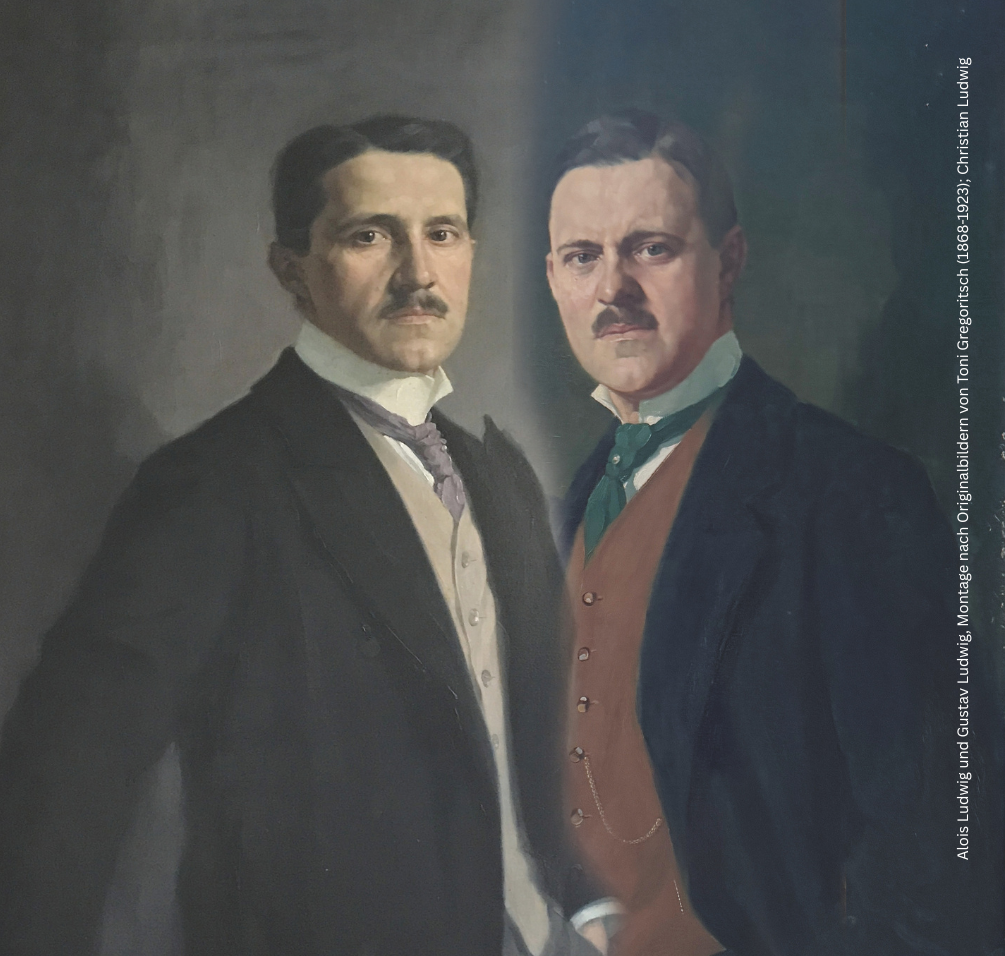
Since 2024, the Touriseum, the South Tyrol Museum of Tourism, along with the Institute for Architectural Theory and History at the University of Innsbruck, has been researching the buildings of the Ludwig Brothers as part of a so-called “Research South Tyrol Project”. This joint research was prompted by the rediscovery of part of the estate of their architectural firm in Meran, now part of the Touriseum collection. Upon reviewing the material, it became clear that this contained many rare items including, for example, large-format drawings by hand in 1:1 scale, created for stucco details such as garlands, “baroquised” shells, etc. The motifs depicted can still be found to this day in and on the hotel buildings designed by the Ludwig Brothers in South Tyrol. All of the architectural drawings have now been catalogued, with the most important digitised. In addition, the canon of material to be examined has been expanded: the descendants of the family have made a special contribution here, in particular the collection of hundreds of photographs belonging to Alois Ludwig’s grandson, Kristian Ludwig. Also worthy of mention is Franz Staffler of the Parkhotel Laurin in Bozen, who has preserved a set of historical plans for his hotel and has now made them available for research purposes. In addition to the buildings appearing in this catalogue and in the exhibition, the research project also focuses on the works of the architects in the cities of Dusseldorf, Cologne, Munich, Vienna and Brno: its results will be published at a later date.
The architects’ family connections were also of historical significance, including in tourism terms. Alois Ludwig’s father-in-law was the industrialist Friedrich Wannieck (1838–1919), also from Brno: this wealthy entrepreneur was not only a frequent visitor to the spa in Meran, but also had built the Villa Salgart, which included an orchard and vineyard. However, ideas of a radical German nationalist character also “travelled” to South Tyrol with Wannieck: these are the subject of separate research.
The meeting between the Ludwig Brothers and Friedrich Wannieck and his ideological circle is significant in other respects as regards the research. In recent years, academic work has increasingly focused on the politicisation of architecture in Austria and Germany before the First World War. Against the backdrop of European nation-building, various forms of German nationalism and related ethnocentric ideologies developed in German-speaking countries –including radical forms of pan-Germanism, groups such as the Guido von List Society that was promoted by Wannieck, and “Ariosophy”. In the course of this process of ideologisation, architecture became an instrument that also served to politically emphasise the notion of “Germanness” – although it should be noted that the term “Austrianness” was not similarly coined, owing to the fact that the complex field of this architecture can also be associated with one language, namely German.
Bettina Schlorhaufer
Next month we continue with new insights on: