
III - The transfer of architecture from North to South
Exhibition in the foyer "Architecture on tour"
01/04/2026
-
08/11/2026
Architecture on tour
Touriseum
By train from one cultural region to another.
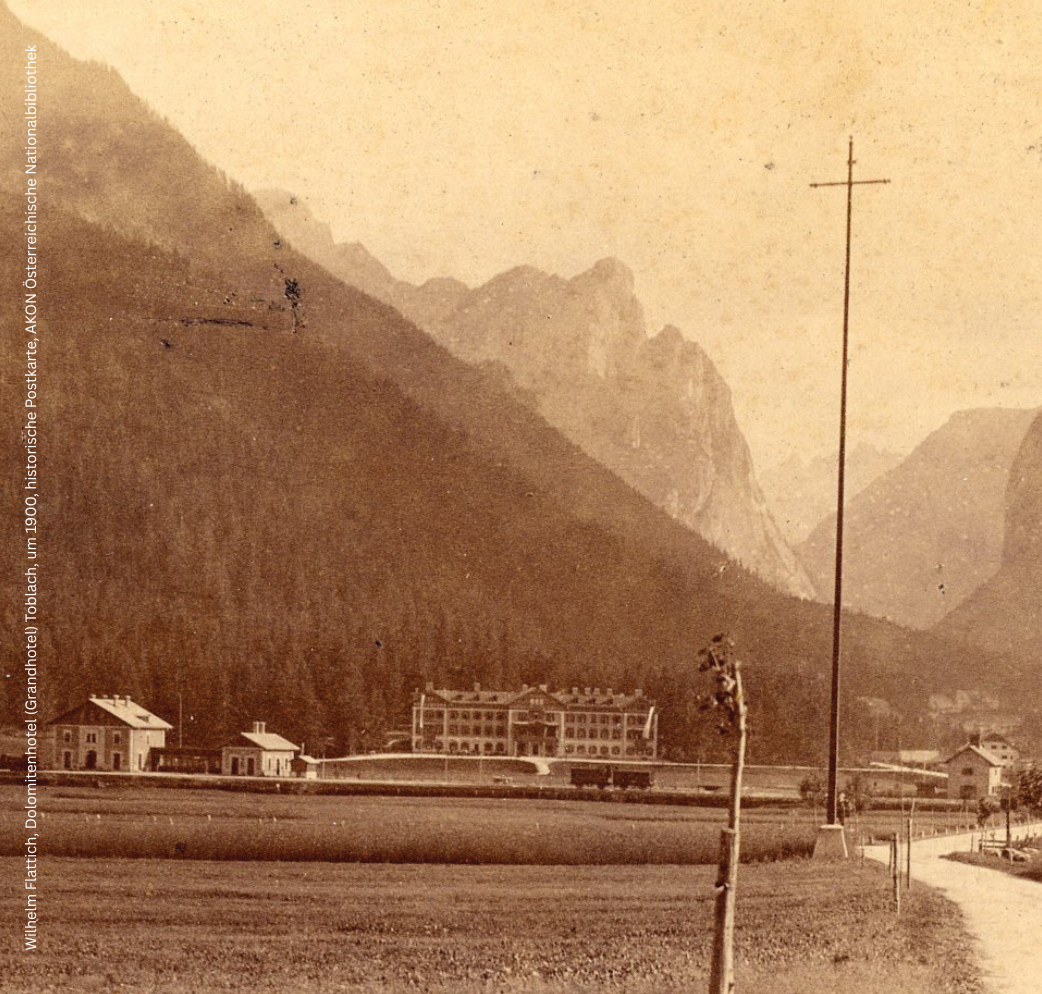
The construction industry in South Tyrol, a transit region, was influenced in many ways by external factors. Traditionally, good artistic relations were maintained with Bavaria in particular, partly because there was no school of architecture in South Tyrol itself. However, budding builders could find good teachers even in the valleys, while there were lively exchanges with neighbouring regions and places of activity. A number of bricklayers and stonemasons from South Tyrol even settled in Munich or other large cities: one example was the father of the architect Lois Welzenbacher (1889–1955), who moved from the Vinschgau Valley to Munich as a stonemason. Last but not least, builders from North Tyrol also worked in the southern part of the province, with such migratory movements depending on the availability of work commissions. The Austrian monarchy and the railways should also be mentioned in the context of the transfer of architecture to South Tyrol. The imperial family sent architects to carry out major construction projects: for example the “Gothic” architect Friedrich von Schmidt (1825–1891), who built Vienna City Hall, came with his students to Bozen to assess the structural damage to Runkelstein Castle and, later, to restore it. In a report to the Imperial and Royal Central Commission for the Study and Preservation of Architectural Monuments – the forerunner of today’s offices of monument preservation – this leading architect warned as early as 1875 against misguided cultural tourism of the wealth of medieval art treasures in the “Etschland” region. Schmidt can thus be seen as South Tyrol’s first tourism sceptic. The construction of the railways also left significant traces in South Tyrol, not least because the engineers were proven specialists, able to transfer their knowledge between construction projects and thus between cultural areas. Karl Etzel (1812–1865) and Wilhelm Flattich (1826–1900) – both later elevated to the nobility – came from Württemberg: their designs were considered groundbreaking not only in technical areas, but also in the field of building construction. They designed a series of railway stations of various sizes and, with their quasi-industrial construction methods, influenced the appearance of entire districts. They also initiated and designed large hotel projects. During the construction of the railway line over the Brenner Pass in the 1860s, Etzel is said to have been inspired by the view of the mountain peaks in the Pflersch Valley to develop tourism in Gossensass, paving the way for the subsequent construction of the Wielandhof Palace Hotel by the Ludwig Brothers. Thereafter, between 1877–78 and 1895, Flattich designed the Dolomitenhotel (also known as the Grandhotel) in Toblach in several stages, bringing to South Tyrol a prototypical Swiss style of construction for spa and mountain hotels.
Bettina Schlorhaufer
Next month we take another look at: