
VI - Long-term guests – private construction for an upscale lifestyle
Exhibition in the foyer "Architecture on tour"
02/09/2026
-
08/11/2026
Architecture on tour
Touriseum
Health tourism is reshaping the urban landscape of Merano.
Health tourism led to significant changes in Meran’s cityscape, with newer building types such as hotels, especially large or grand hotels, making a considerable mark. The Grand Hotel Meranerhof, for example, described by contemporaries as a “colossus”, dominated the city’s skyline to such an extent that its removal from the city centre (nowadays the Therme Meran) was seen as an act of liberation.
There is also a widespread misconception that hotels of this type offered high levels of comfort and luxury, which were not in fact provided to their temporary residents at that time.
By today’s standards, rooms in the early days of the hotel industry were spartan in their furnishings; they were furthermore occupied by people of different social classes, which permitted only limited social segregation. People would therefore only stay in hotels when this was unavoidable.
Long-term guests, who often stayed for weeks at a time while undergoing spa treatments, as was often the case in Meran, would therefore prefer to find private accommodation. This meant that – in particular in the neighbouring settlement of Mais – former farm estates were divided up, with residential houses and villas constructed there to meet the resulting demand. Such accommodation demanded superior design, thus prompting highly trained architects, many of whom had attended universities in Vienna or Munich, to move to Meran. Among the best known of these were Karl Moeser (1837–1888), who had studied in Vienna, and Franz Lewy Hoffmann (1851–1917), a graduate of the universities of Dresden and Munich.
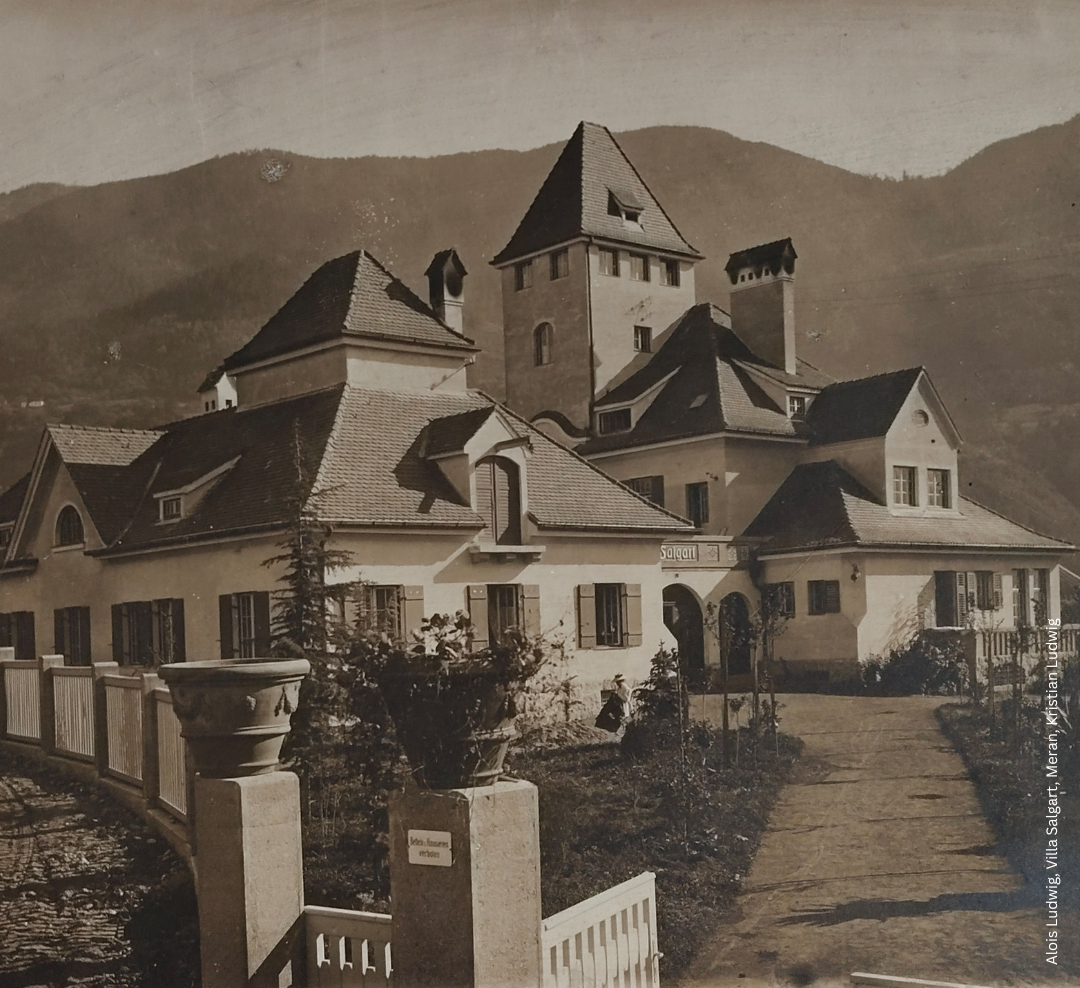
Other architects from the Bavarian state capital, such as the Ludwig Brothers or Emanuel von Seidl (1856–1919), from 1906 ennobled as the Ritter von Seidel, “travelled” to Meran with their principals, but each only realised one project there. Around 1900, Emanuel von Seidl designed the Villa Erhard on the Winkelweg: with its gables and their large volutes, and its small tower, the building gives the impression of a Baroque-style garden palace; the Villa Salgart, designed by the Ludwig Brothers, is discussed at the beginning of the catalogue section of this publication. Both residences were built by the local building firm of Musch & Lun, which had particularly good connections to Munich and thus played a significant role in the transfer of architecture from that city to Meran.
The special exhibition at the Touriseum in 2026 will focus on the fact that architecture not only “travelled” in terms of design, but also brought politics, power and influence across territories to a land such as South Tyrol.
Bettina Schlorhaufer
More insights on the topic
The Palasthotel Wielandhof, Colle Isarco
coming next month.